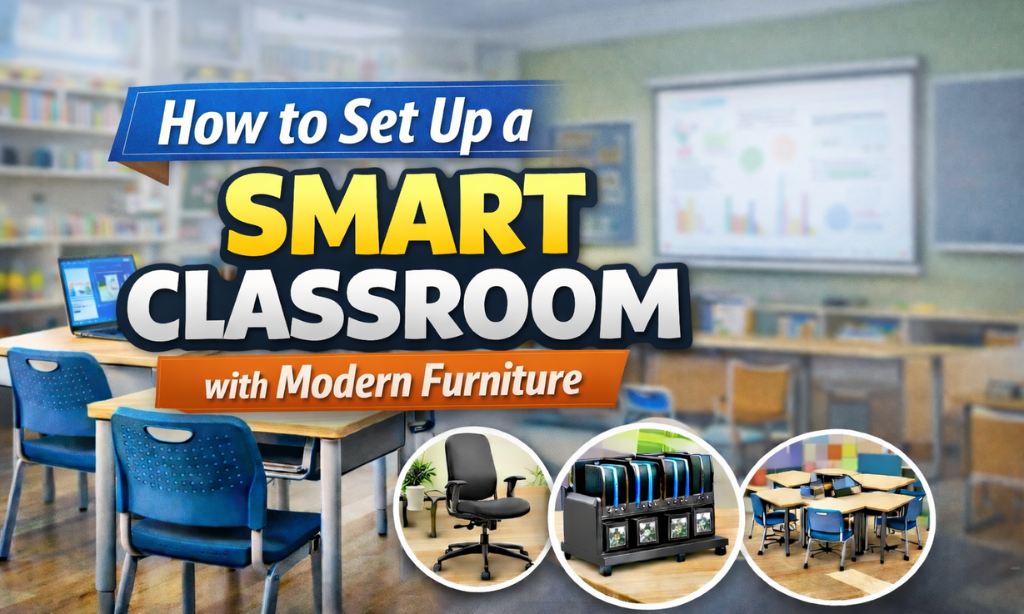
Education in India is changing fast. Schools are moving beyond blackboards and fixed wooden benches. Today, parents expect technology-enabled classrooms, interactive learning methods, and comfortable environments where students can focus and grow. But here’s something many institutions overlook, technology alone does not make a classroom smart. The real transformation begins with smart classroom furniture.
If you are planning a smart classroom setup in India, this guide will help you understand how modern classroom furniture plays a powerful role in improving learning outcomes, student comfort, and overall classroom efficiency.
Smart Classroom Furniture Setup Guide
Here are complete step-by-step guide for setting up smart classroom furniture:
Step 1: Understand How the Classroom Will Be Used
Before selecting any smart classroom furniture, ask a simple question: how will this classroom function daily?
- Will teachers conduct group discussions?
- Will students use tablets or laptops regularly?
- Will the room be used for multiple subjects?
The layout should match the teaching style. Many schools still follow a traditional row system even after installing digital boards. That limits interaction. Modern classrooms work better when the furniture allows movement and reconfiguration without effort.
Planning the usage first helps avoid costly mistakes later.
Step 2: Replace Fixed Benches with Flexible Desk Systems
Traditional long benches are durable, but they restrict flexibility. In a smart classroom setup in India, individual or two-seater desks work much better. They allow quick rearrangement for group work, presentations, or workshops.
Modular classroom furniture is especially useful here. Lightweight desks with strong metal frames and scratch-resistant tops are practical for daily school use. The goal is not luxury, it is flexibility and durability.
When desks can be moved easily, teachers can shift from lecture mode to discussion mode within minutes. That simple change improves engagement significantly.
Step 3: Prioritize Ergonomics, Not Just Design
A classroom may look modern, but if students are uncomfortable, learning suffers. Poor posture leads to distraction, back pain, and reduced focus, especially in senior classes where students sit for long hours.
Ergonomic school desks and chairs are designed to support natural posture. The desk height should match the chair height. Foot placement should be stable. The writing surface should allow relaxed shoulders and arms.
For primary sections, safety matters even more. Rounded edges, smooth finishes, and stable frames reduce accidents. Investing in ergonomic classroom furniture is not an extra expense, it directly supports better concentration and discipline.
Step 4: Make Space for Technology Integration
In a digital classroom, devices need proper space. Laptops, tablets, charging cables, and projectors all require organized planning.
Modern classroom furniture should include thoughtful details such as cable management space, storage drawers for teachers, and secure device storage cabinets. Without these, classrooms quickly become cluttered.
Many schools upgrading to smart classroom furniture in India now include charging trolleys or lockable cabinets to protect devices. This small addition prevents damage, misplacement, and unnecessary repair costs.
Step 5: Design a Practical Teacher Workstation
Teachers manage both instruction and technology in a smart classroom. A simple table is no longer enough.
A well-designed teacher workstation should have space for a laptop, documents, and digital controls. Storage drawers help maintain order. Proper cable routing prevents tangled wires.
When the teacher’s area is organized, the entire classroom runs more smoothly.
Step 6: Use Durable Materials That Withstand Daily Wear
School furniture faces heavy daily use. Students lean, shift, drag desks, and use surfaces continuously. Low-quality materials wear out quickly, leading to repeated replacements.
Choose rust-resistant metal frames, high-pressure laminated tops, and termite-resistant wooden components where required. Easy-to-clean surfaces are important, especially in primary classrooms.
Durable classroom furniture reduces long-term maintenance costs and protects your investment.
Step 7: Create Functional Learning Zones
A smart classroom does not need to be large to be effective. Even in a limited space, you can create zones.
One section can remain the main teaching area. Another can function as a small discussion cluster. A corner can be used for reading or project-based work. Modern school interior furniture allows schools to break the monotony of a single rigid layout.
These subtle changes encourage participation and make the environment feel active rather than restrictive
Long-Term Benefits of Smart Classroom Furniture
Schools that invest thoughtfully in modern classroom furniture often notice improvements beyond infrastructure.
Students participate more during discussions. Teachers find it easier to manage activities. Classrooms stay organized. Parents visiting the campus notice the difference immediately.
A well-designed smart classroom setup in India also strengthens the institution’s image. Infrastructure plays a strong role in admission decisions today. Comfortable, flexible classrooms signal that the school values both innovation and student well-being.
Explore More:
- Play Area Furniture
- Primary School Furniture
- Secondary Classroom Furniture
- College and Institute Furniture
Conclusion
Setting up a smart classroom is not about trends or just installing digital boards. It is about creating a practical, comfortable, and flexible learning environment where students can focus and teachers can teach effectively.
By choosing ergonomic, durable, and modular classroom furniture, schools can build a space that truly supports modern education. When the foundation is strong, technology and teaching methods work better together, creating a classroom that is ready for the future.