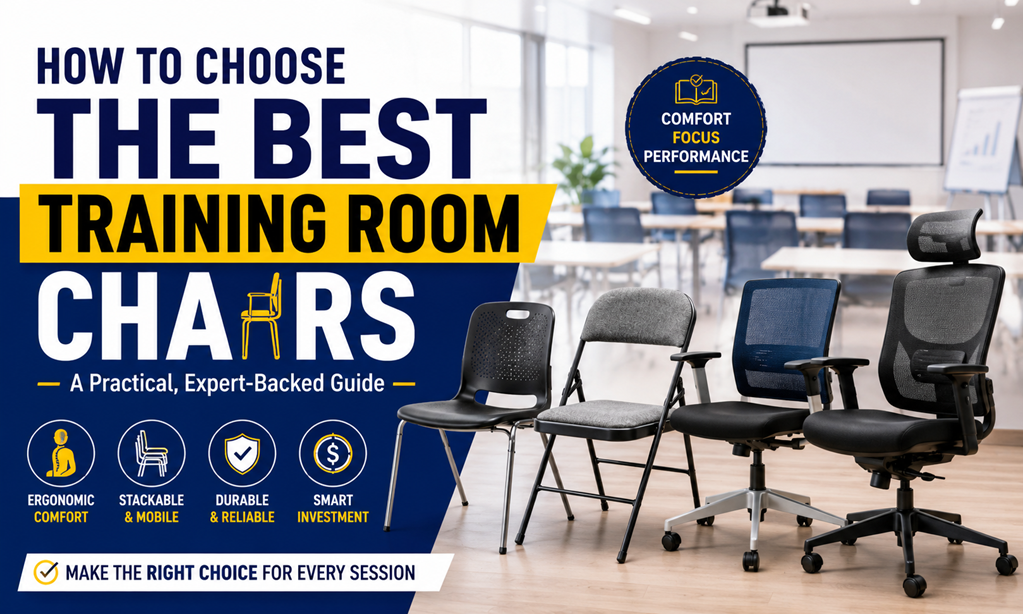
How to Choose the Best Training Room Chairs: A practical, expert-backed guide covering ergonomics, chair types, budgeting, and everything you need to make the right choice for your training space.
Attendees spend hours seated during workshops, seminars, and corporate training sessions. An uncomfortable chair kills focus, increases fatigue, and drives negative feedback, no matter how great the content is. Research consistently shows that physical comfort directly influences cognitive retention and engagement.
Choosing the best training room chairs also signals professionalism and care for attendees. It’s an investment that pays back in productivity, satisfaction scores, and repeat bookings.
7 Factors Every Buyer Must Evaluate
- Ergonomics: Lumbar support, seat depth, and back angle are non-negotiable for sessions over 90 minutes.
- Mobility & Stackability: Rooms must be reconfigured fast. Look for chairs on castors or ones that stack 8–12 high.
- Dimensions: Seat height 43–52 cm suits most adults. Match chair width to table depth and row spacing.
- Upholstery & Maintenance: Mesh breathes better in warm rooms. Fabric looks sharp but traps dust. Vinyl wipes clean easily.
- Weight capacity: Standard chairs handle 110–130 kg. Inclusive spaces need heavy-duty options rated to 160 kg+.
- Aesthetics & Branding: Shell and frame colours should complement the room design. Custom upholstery can reflect brand identity.
- Total Cost of Ownership: Factor in warranty length, spare parts availability, and replacement cost per chair over 5–10 years.
Which Type Is Right For Your Training Room?
There’s no one-size-fits-all. The best chair type depends on session length, room layout, and audience.
1. Stacking chair (Budget-Friendly)
Polypropylene shell, metal legs. Lightweight, storable, low cost. Best for short sessions and large groups.
2. Folding Padded Chair (Mid-Range)
Padded seat and back, folds flat for storage. Good for mixed-use rooms. Comfortable for half-day sessions.
3. Training Chair On Castors (Mid-range)
Upholstered seat, swivel base with lockable wheels. Ideal for collaborative and breakout sessions.
4. Ergonomic Task Chair (Premium)
Full lumbar adjustment, armrests, tilt control. Essential for full-day training or computer-based learning.
5. Lecture / Tiered seating (Specialist)
Fixed or linked row seating with an integrated writing tablet. Ideal for large-capacity auditorium-style rooms.
What Good Ergonomics Looks Like In A Training Chair
Poor posture during long sessions causes back pain, neck strain, and reduced concentration. A well-designed training chair supports the natural S-curve of the spine and allows easy repositioning.
- Lumbar support that curves gently inward, keeping the lower back from slumping.
- Seat pan depth of 38–45 cm, leaving a 2–3 finger gap behind the knee.
- Seat height adjustability between 43 and 52 cm to suit different body types.
- Slight forward tilt option (2–5°) for active listening and writing tasks
- Armrests (if included) at elbow height — not too high, which raises shoulders.
- Breathable seat material to prevent heat build-up over multi-hour sessions.
Mistakes To Avoid When Buying Training Room Chairs
1. Prioritising Looks Over Comfort
A sleek chair that causes back pain after 45 minutes will generate complaints regardless of how premium it looks.
2. Ignoring Room Layout Needs
Fixed-base chairs in a room that needs frequent reconfiguration will slow down every session setup.
3. Underestimating Quantity Needed
Always buy 10–15% more than your maximum capacity to account for breakages and mixed setups.
4. Skipping a Trial Period
Always test chairs with real users before bulk ordering. What feels fine for 10 minutes may be painful at 3 hours.
5. Overlooking Warranty Terms
Cheap chairs with 1-year warranties often cost more over a 5-year period than a quality chair with a 10-year guarantee.
Your Pre-Purchase Checklist
- Define typical session length (under 2 hrs / half-day / full-day)
- Measure room dimensions and calculate chairs needed + 10% buffer
- Decide: fixed layout or flexible/reconfigurable room?
- Set per-chair budget aligned to usage frequency
- Test at least 2–3 chairs with real attendees before ordering
- Check stackability height and storage footprint
- Confirm the weight capacity covers all likely attendees
- Verify warranty period and manufacturer spare parts policy
- Check upholstery for cleaning ease and stain resistance
FAQs: Best Training Room Chairs
Q. What is the best chair for a training room?
For full-day sessions, an ergonomic task chair with lumbar support and height adjustment is best. For short presentations or large-group events, quality stacking chairs offer the best value and flexibility.
Q. Should training chairs have armrests?
Armrests help during long sessions by reducing shoulder strain. However, they add width and can hinder movement in tight rows. Choose armrest-free options for high-density layouts and armrested chairs for L-shaped or boardroom-style arrangements.
Q. How many chairs do I need per square metre?
A classroom layout typically requires 1.8–2.2 m² per person, including walkways. Theatre-style seating can be tighter at 0.8–1.2 m² per seat. Always check local fire safety regulations for maximum occupancy limits.
Q. Mesh vs fabric seat — which is better?
Mesh is better for ventilation and all-day comfort in warm rooms. Fabric looks more corporate and is quieter, but can retain heat and harbour dust. Vinyl or faux leather is easiest to clean and most hygienic for high-turnover environments.
Q. How long should training chairs last?
A quality training chair used daily should last 7–10 years. Budget stacking chairs used occasionally can last 5+ years. Always check the manufacturer’s warranty. Leading brands typically offer 5–10-year structural guarantees.
Conclusion
Choosing the best training room chairs is about balancing comfort, functionality, durability, and budget. The right chairs improve focus, support better learning outcomes, and create a more professional training environment.