Setting up a training room sounds simple on paper. Get some chairs, a few tables, maybe a projector done, right?
Not really.
Anyone who has sat through a 6-hour training session on a hard plastic chair, or tried to take notes on a table that wobbles every time someone breathes, knows exactly what I mean. The furniture in a training room can make or break the entire experience for both the trainer and the participants.
So if you are about to furnish a training or seminar room in India, this guide will help you do it right without wasting money or making decisions you will regret six months later.
1. Start With the Layout; Everything Else Follows
The first question is not “which chair should I buy?” It is “how will this room actually be used?”
This matters because a room used for interactive workshops needs completely different furniture than one used for large lecture-style sessions. Get the layout wrong, and even the best furniture will feel off.
Here are the most common setups you will see in Indian corporate offices, training centres, and institutes:
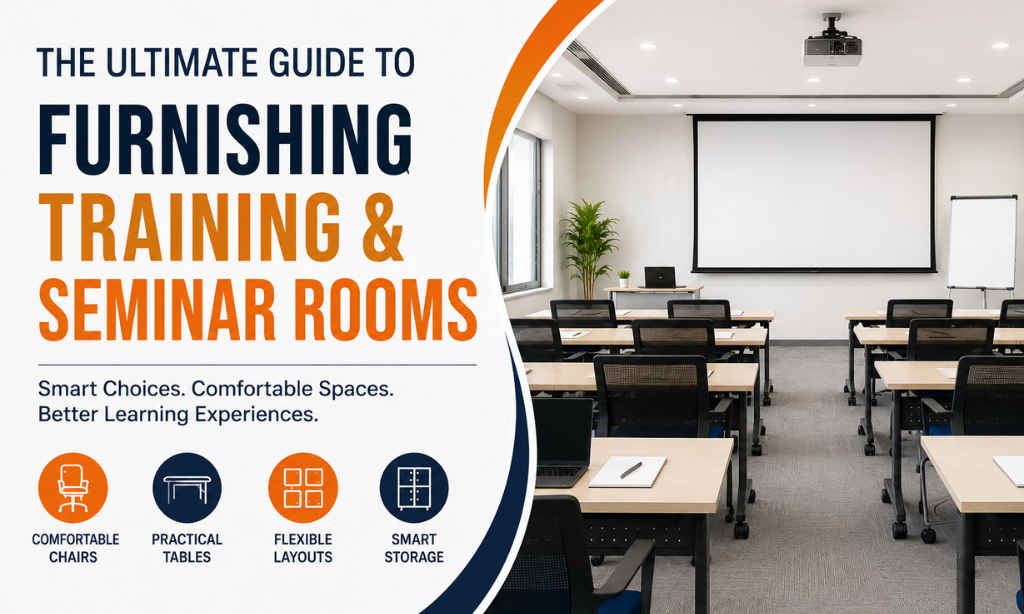
Classroom style — rows of tables facing the front. Works well for large groups and presentations where most of the talking is done by one person. This is the default in most Indian setups, and honestly, it works fine when done properly.
U-shape — tables arranged like a horseshoe with the open end facing the trainer. Great for discussions, workshops, and sessions where you want everyone to see each other. Works best for groups between 12 and 25 people.
Boardroom style — one big central table; everyone sits around it. Suits small, senior-level sessions, leadership training, strategy workshops, that kind of thing.
Cluster or pod style — small groups of tables pushed together to form islands. Excellent for group activities and collaborative learning. More common in modern L&D setups and IT company training programmes.
Pick your layout first. Then decide on furniture. Not the other way around.
2. Chairs: The One Thing You Should Not Cheap Out On
I will be blunt here: if there is one place to spend a little more, it is the chairs.
People in your training sessions are going to sit for 4, 6, sometimes 8 hours. If the chair is uncomfortable after the first hour, you have already lost them mentally. No amount of good content or fancy slides will fix a bad chair.
So what should you look for?
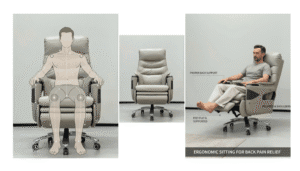
Back support is non-negotiable. Look for chairs that have a slightly curved backrest that follows the natural shape of the spine. Chairs with lumbar support are even better. Avoid flat, slab-style backrests; they look sleek but kill your back.
The seat should have some cushioning. Hard plastic seats are fine for a quick meeting. For training sessions that run for hours, you need at least a modest amount of padding.
Stackable design saves you a lot of headache. Training rooms in India are often multi-purpose; sometimes it is a seminar, sometimes a team meeting, sometimes an event. Chairs that stack easily mean you can clear the room in minutes and store everything without needing a separate storage room.
Writing pad chairs are genuinely useful. If your layout does not use tables, like a theatre-style or auditorium setup, chairs with attached writing pads are a smart choice. Participants can take notes without needing a table.
For most training rooms in India, mesh back stackable chairs or cushioned fabric stackable chairs hit the sweet spot between comfort, durability, and price.
3. Tables: Practical Over Pretty
Training room tables get moved, folded, stacked, rearranged, and dragged across floors dozens of times a month. They need to be tough, not just good-looking.
Folding tables are the most practical option for most Indian training rooms. They fold flat, store easily against a wall, and let you change the room layout whenever you need to. If your room serves multiple purposes, this is the obvious choice.
Standard rectangular tables work well when the layout is fixed, such as in a permanent classroom setup or a dedicated boardroom. They feel more solid and professional, but they are harder to move and rearrange.
On size, a 5-foot by 2-foot table (roughly 150cm x 60cm) is the standard for training rooms in India. It gives each participant enough space for a laptop, a notebook, and a water bottle, which covers about 90% of use cases.
One thing people often overlook is table height. Standard 30-inch height works for most setups. But if your room will be used for both sitting and standing sessions, consider height-adjustable tables. They cost more but add real flexibility.
4. The Trainer’s Area Deserves Its Own Attention
A lot of people plan the participant area carefully and then forget about the trainer completely. Do not do this.
The trainer is on their feet, moving around, switching between the laptop, the board, and the audience for hours. They need space to move and a setup that works for them.
Keep a dedicated zone at the front with at least 5 to 6 feet of clear space between the first row of participant tables and the front wall. This gives the trainer room to walk, point at the screen, and engage with the room without bumping into people.
The trainer’s table should be a little bigger than participant tables, at least 4 feet wide, and placed off to one side so it does not block the screen. A simple ergonomic chair at the front is a nice touch too, for moments when the trainer wants to sit during group exercises.
5. A Few More Things Worth Thinking About
Storage — training rooms need somewhere to keep handouts, stationery, extension cords, and AV accessories. A basic storage cabinet or a low credenza at the side of the room solves this neatly.
Cable management — in Indian training rooms, this is almost always an afterthought, and it always causes problems. Laptops, projectors, chargers, microphones, and cables add up fast. Tables with built-in cable grommets help a lot. If your tables do not have them, cable covers on the floor are the next best option.
Space per person — do not pack the room. A comfortable training room in India should give each participant at least 25 to 30 square feet of space. Too tight and people feel cramped, restless, and distracted.
6. Before You Place the Order — Run Through This
- Layout finalised — classroom, U-shape, boardroom, or cluster?
- Stackable chairs with back support selected?
- Folding or fixed tables are chosen based on how often you will rearrange?
- Trainer’s area planned with enough space to move?
- Storage unit included?
- Cable management sorted?
- Minimum 25 sq ft per person calculated?
Get these right and your training room will work well for years without needing a redesign.
Conclusion
A well-furnished training room is not about spending a lot. It is about making smart choices, picking chairs that people can actually sit in for hours, tables that can be rearranged without drama, and a trainer’s area that lets the session flow naturally.
At Aadinath Furniture, we work with corporate offices, training centres, coaching institutes, and educational organisations across India to set up practical, comfortable, and durable training rooms. We have options across every budget, and our team can help you plan the right setup for your room size and usage.
Feel free to reach out or browse our training room furniture collection for chairs, folding tables, and seminar room setups with delivery across India.
Ready to create a training room that keeps participants comfortable, engaged, and productive? Aadinath Furniture offers ergonomic training chairs, durable folding tables, seminar room setups, and customised solutions for corporate offices, institutes, and training centres across India. Talk to our experts today for a free consultation and find the perfect furniture setup that fits your space, budget, and training needs.